


In many small plants the same thing happens. Maintenance replaced the light fixtures, Purchasing asked for boxes with recycled content and someone has been separating cardboard in the yard for two years. All of that counts. But when a large customer asks who owns the environmental topic and what numbers they have, the answer is slow or never comes. An environmental management system exists to solve exactly that: turning scattered actions into something with an owner, indicators and follow-up.
This guide explains how to build one in an industrial SME, without a sustainability department and without getting certified first. It answers five questions: what an environmental management system is, where to start, what it looks like in a factory, whether to implement or get certified and what changed with the new edition of ISO 14001.
Let's go in that order.
An environmental management system is the set of owners, indicators, procedures and reviews an organization uses to control its environmental impact and improve it continuously.
The international reference is the ISO 14001 standard, which sets requirements for these systems and is designed for any type of organization, regardless of its sector or activity. That includes a 120-person plant. A system does not require a sustainability office or software. It requires someone to answer for the topic, numbers to exist and someone to review them on a date set in the calendar.
In practice, the obstacle is almost never technical. Gas consumption lives in the invoice Administration pays, the warehouse manager knows the waste and nobody has energy by line. Each area does its part and none sees the whole. A system brings those pieces together in one place.
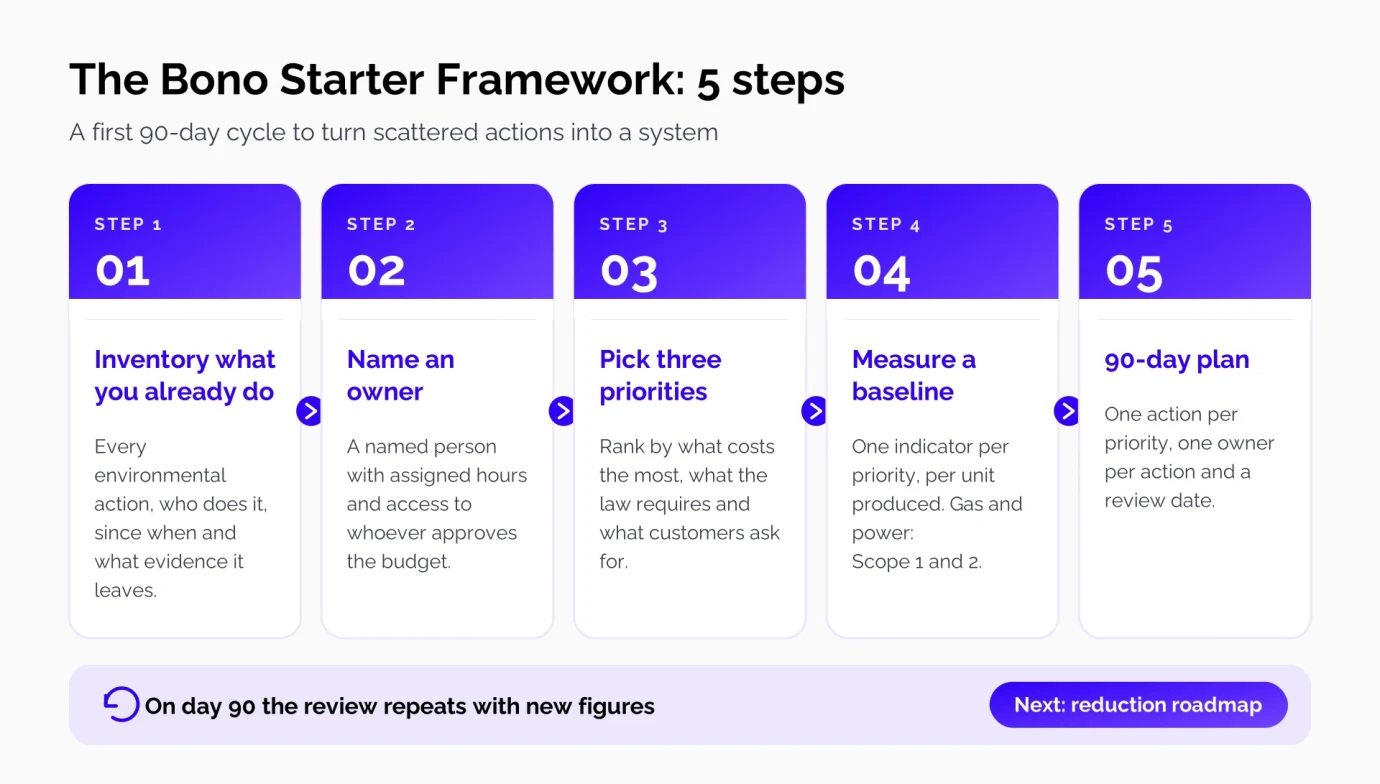
Start with five moves: inventory what you already do, name an owner, pick priorities, measure a baseline and set a 90-day plan. ISO suggests starting by identifying key environmental aspects (waste, water, energy and emissions), reviewing legal obligations, measuring resource use and assigning responsibilities. The Bono Starter Framework puts those moves into a short sequence for an SME.
Step 1. Inventory what you already do. Walk the plant with one person from each area (maintenance, production, purchasing, warehouse and administration) and write down every environmental action, even if it seems minor. For each one, record who does it, since when and what evidence it leaves: an invoice, a log, a waste manifest. What leaves no evidence still gets written down, labeled "no record". The list is usually longer than leadership expected, and the evidence shorter.
Step 2. Name an owner with a first and last name. A committee dilutes responsibility. Pick one person, with hours assigned in their week, who has access to whoever approves the budget. In an SME this is usually the maintenance manager, the quality manager or the EHS (environment, health and safety) manager if there is one. In a 2017 note on its guide for SMEs, ISO advises leaning on the company's informal management structures instead of building new bureaucracy. If there is already a weekly production meeting, the environmental topic goes in there with ten minutes.
Step 3. Pick three priorities. With the inventory on the table, rank the environmental aspects by three criteria: what costs the most, what the law requires and what your customers ask for. Our position is that an SME gains more from three well-measured priorities than from ten half-measured ones. The other seven go on a waiting list with a review date.
Step 4. Measure a baseline and indicators. Each priority gets an indicator and a data source. It helps to express it per unit produced, for example kilowatt hours per tonne. This is also where the carbon footprint comes in. The GHG Protocol Corporate Standard (the international standard for greenhouse gas inventories) defines direct emissions, or Scope 1, as those from sources the company owns or controls, and Scope 2 as those from generating the electricity it buys and consumes. For a factory, the gas in a boiler is Scope 1 and the power bill is Scope 2.
At Bono, each plant captures those consumption figures in forms with access by owner, and the carbon accounting platform calculates Scope 1 and 2 in its Starters version. The indicator comes from the same data you already pay for every month. Data has to lead somewhere.
Step 5. Set a 90-day plan with a review date. One action per priority, one owner per action and a date when the owner presents the numbers to leadership. On day 90 the review repeats with new figures. That cycle of follow-up, measurement and continuous improvement is what turns a list of good intentions into a system.
With the baseline there is now something to organize. The next step is the reduction roadmap: rank emission sources from largest to smallest and decide which project tackles each one. Bono builds that roadmap on measured data, so the system stops being a compliance file and becomes a list of projects. Fewer reports. More projects.
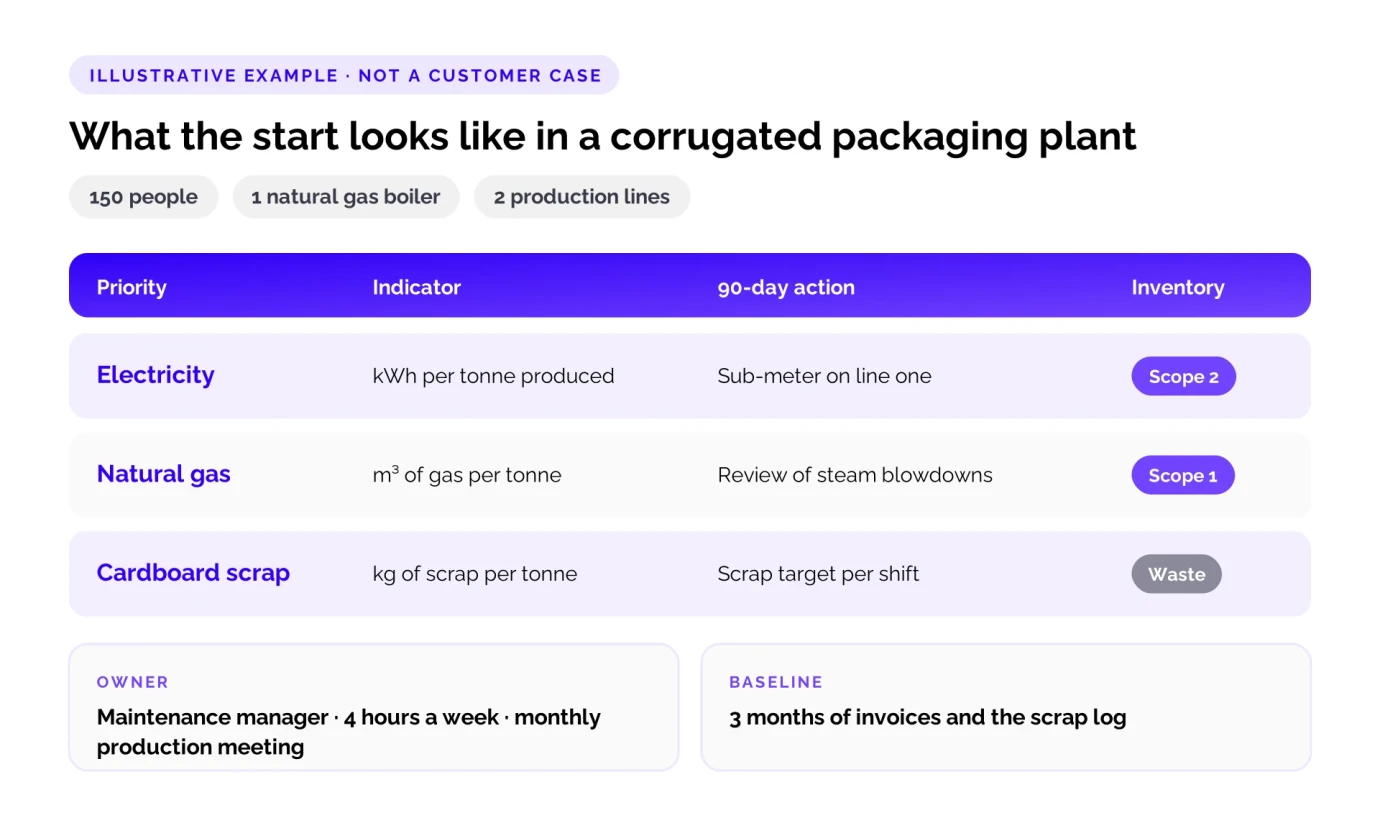
This is an illustrative example, not a customer case: a corrugated packaging plant with 150 people, a natural gas boiler and two production lines.
The inventory turns up three actions nobody had put together: LED fixtures in the warehouse, cardboard separation in the yard and basic treatment of wash water to meet discharge requirements. Only the cardboard separation leaves evidence, in a warehouse log. The maintenance manager becomes the owner, with four hours a week, and presents results at the monthly production meeting.
The three priorities are electricity, natural gas and cardboard scrap. The indicators are kilowatt hours per tonne produced, cubic meters of gas per tonne and kilos of scrap per tonne. The baseline comes from three months of invoices and the scrap log. Boiler gas counts as Scope 1 and electricity as Scope 2, so the same data feeds the system and the emissions inventory.
The 90-day plan has one action per priority: a sub-meter on line one, a review of steam blowdowns and a scrap target per shift. What changes at 90 days is that the plant stops guessing. It has a baseline, an owner and a review date.
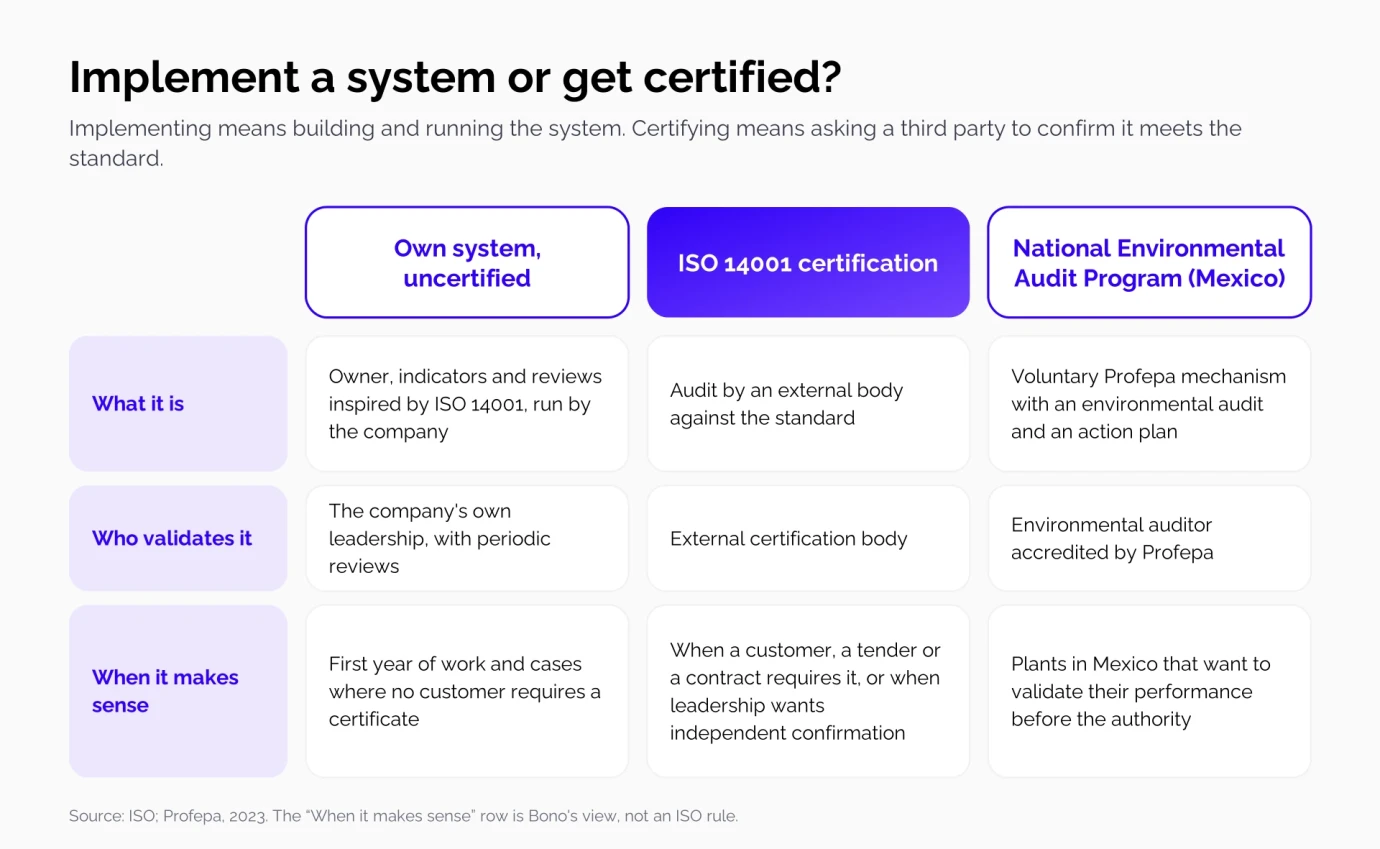
Implementing means building and running the system. Certifying means asking a third party to confirm it meets the standard. They are two separate decisions. ISO 14001 certification is voluntary, and ISO does not issue certificates: certification is done by an external body. ISO also recognizes that, in some industries, certification is a legal or contractual requirement.
The last column is Bono's view, not an ISO rule. Our position is that an SME should build the habit before paying for validation. A system that exists only to pass the audit switches off when the auditor leaves. The company that has already measured for one or two cycles arrives at certification day with records, not intentions. That is where Bono provides infrastructure: consumption and emissions stay organized by plant and by period, and any auditor or customer can review them without asking for a new Excel file. Excel is an audit risk, not a measurement tool.
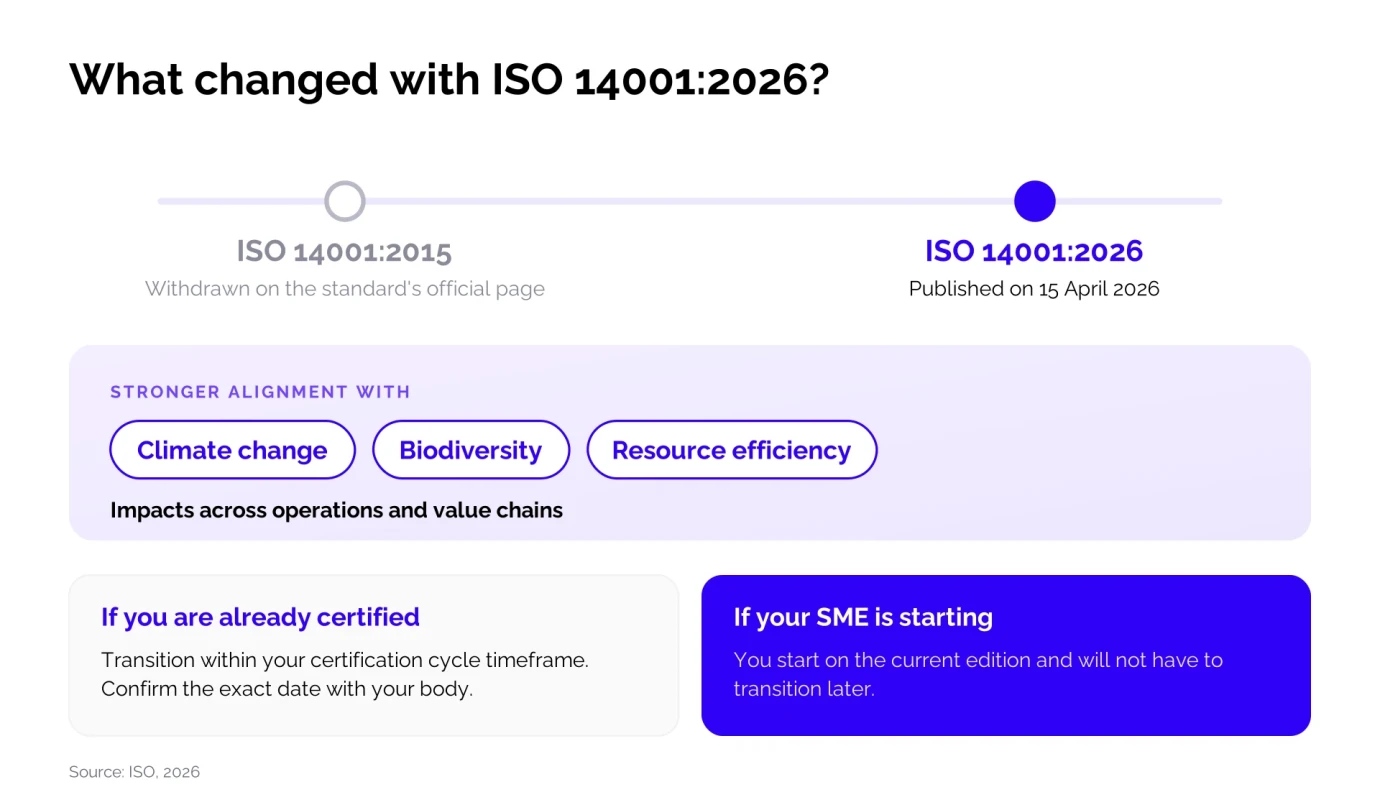
ISO published ISO 14001:2026 on 15 April 2026 and the 2015 edition appears as withdrawn on the standard's official page. According to ISO, the new edition seeks stronger alignment with climate change, biodiversity and resource efficiency, and proposes managing impacts across operations and value chains. ISO's announcement does not detail which specific requirements change, so the text of the standard or your certification body are the places to check that detail.
For a company that is already certified, ISO states that the transition must happen within the timeframe of its certification cycle. Confirm the exact date with your body. For an SME that is starting, the news is good: you start on the current edition and will not have to transition later. Our reading is that the emphasis on climate change makes it more natural to connect the system to an emissions inventory from day one.
If your plant is in Mexico, there is also the National Environmental Audit Program, which Profepa describes as a voluntary mechanism of the Federal Government. According to its 2023 leaflet, an environmental auditor accredited by Profepa carries out the audit and verification, and the company works with an action plan.
Our reading is that a system already running hands the auditor what takes longest to gather: organized evidence of consumption, waste and owners. This article does not cover regulation in other countries in the region, which changes by jurisdiction.
Yes. Certification is voluntary and is issued by an external body, not ISO. You can run your own system with an owner, indicators and reviews, use ISO 14001 as a reference and decide later whether a customer, a tender or leadership justifies certification.
The Bono framework sets out a first 90-day cycle: inventory, owner, priorities, baseline and plan. The real time depends on how many plants you have and how scattered the data is. If the invoices and logs already exist, the bottleneck is usually gathering them.
A named person, with assigned hours and access to whoever approves the budget. In an SME this is usually maintenance, quality or EHS. What matters is that they present numbers at a meeting with a fixed date. A committee without an owner dilutes responsibility.
One per priority, expressed per unit produced: kilowatt hours per tonne, cubic meters of gas per tonne or kilos of scrap per tonne. With those consumption figures, Bono calculates each plant's Scope 1 and 2 emissions, so the same data serves the system and the inventory.
Every quarter without an owner or a baseline is a quarter in which what your plant already does shows up in no number you can show.
Prefer to talk it through? Book 15 minutes with Bono. We will show you where to start before the call ends: