


To see where that evidence breaks, it helps to start with the supply chain.
Scope 3 greenwashing appears where the inventory is largest and the conversation with suppliers is least frequent. Among the companies that reported to CDP, the organization that receives their environmental disclosure, supply chain Scope 3 emissions in 2023 were on average 26 times their operational emissions. The CDP and Boston Consulting Group (BCG) release, from June 2024, adds that only four in ten companies engage with their suppliers on climate.
That gap between what is declared and what can be traced is the subject of this article. It answers five questions: what Scope 3 greenwashing is, where it starts inside the inventory, what evidence each claim needs, how to avoid it with supplier data and what changes by country.
Before answering them, we need to pin down the term.
Scope 3 greenwashing is declaring a figure, a coverage level or a value chain reduction with more precision than the inventory can prove. It is the working definition we use at Bono. Scope 3 covers the indirect emissions from the value chain, and the Corporate Value Chain (Scope 3) Standard of the Greenhouse Gas Protocol (GHG Protocol) organizes them into 15 categories.
In practice, the person who signs the claim is in Sustainability, and the person who owns the supplier relationship is in Procurement. The number reaches the report before anyone has asked where it comes from.
That is the uncomfortable truth of the topic. It does not require bad faith: it is enough that the calculation and the claim are written in different departments.
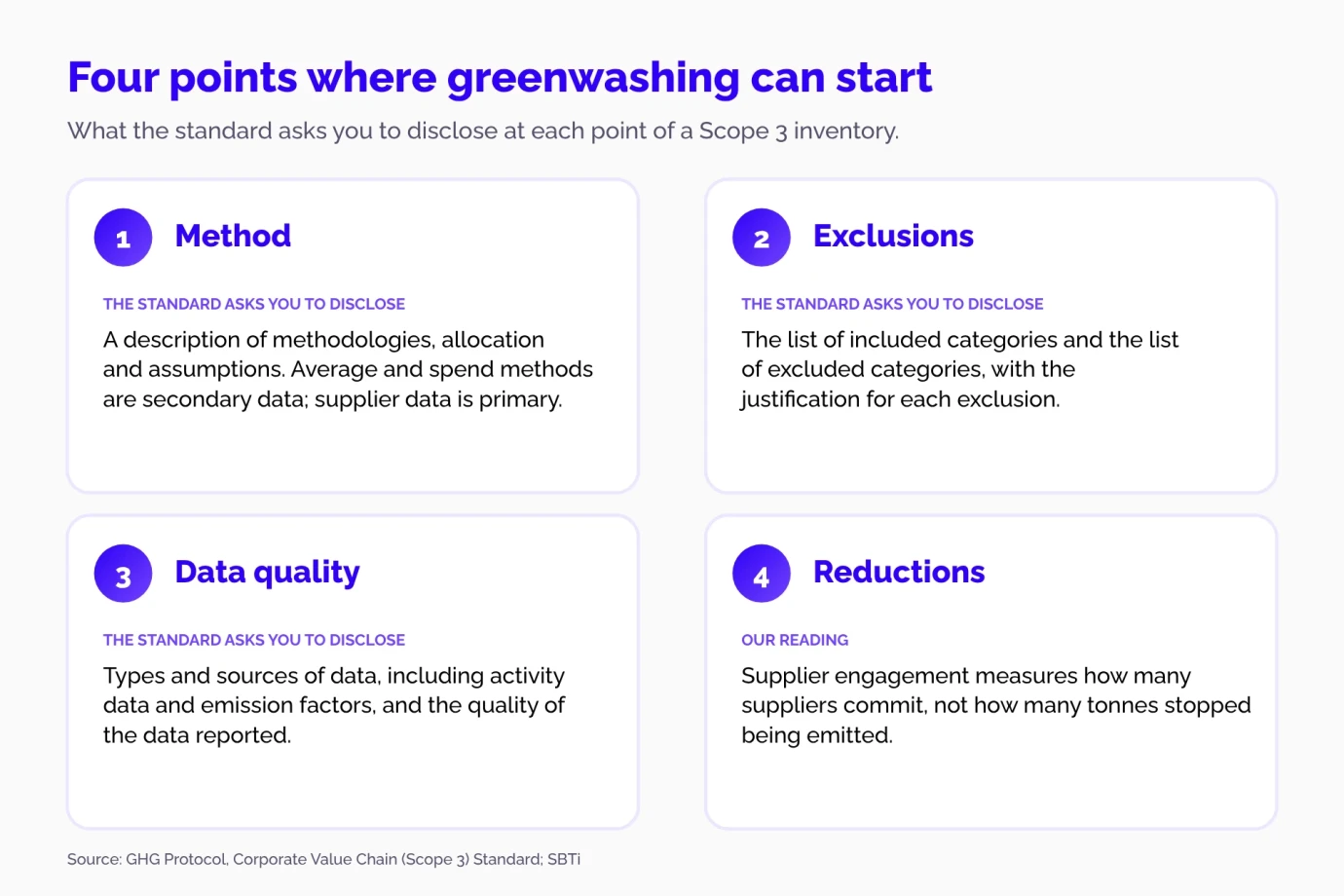
It starts at four points: the calculation method, the exclusions, the data quality and the reductions attributed to suppliers. At the first three, the GHG Protocol standard asks you to disclose exactly what a vague claim leaves out.
The first point is the method. For Category 1, purchased goods and services, the GHG Protocol accepts average-data and spend-based methods, which use secondary data, that is, industry averages. Its technical guidance defines primary data as data from specific activities within the value chain, and supplier data is among them. The problem appears when a figure calculated with averages is presented as if it came from suppliers.
The second point is the exclusions. The standard asks you to report the list of included categories and the list of excluded categories, with a justification for each exclusion. A total without those lists reads as a complete inventory, even if it is not one.
The third point is data quality. The standard asks you to describe the types and sources of data, including activity data and emission factors, as well as the quality of the data reported, the methods, the allocation and the assumptions. Its transparency principle requires a clear audit trail.
Specific data is not always accurate data. The technical guidance warns that a supplier’s data can be less accurate than the industry average for a product. Granularity, source reliability and allocation techniques all play a part.
The fourth point is the reductions. A supplier engagement target, which the Science Based Targets initiative (SBTi) allows as a short-term option, aims to get suppliers to set science-based targets. Our reading is that this progress should not be presented as an emissions reduction, because it measures how many suppliers commit and not how many tonnes stopped being emitted.
The GHG Protocol is also revising its standard. Its March 2026 update proposes disaggregating Scope 3 by data type and clarifies that data type does not by itself indicate data quality. It is a draft subject to change, and it reinforces the same idea: the data label does not replace its validation.
Each claim needs to show its method, its coverage and its data quality. The table summarizes what evidence each one asks for and where it breaks.
| Claim | What you should be able to show | Where it breaks |
|---|---|---|
| Scope 3 total | Included categories, method by category and assumptions | Published without a list of exclusions or a description of the method |
| Spend-based calculation | That it is secondary data and which categories it covers | Presented as measured data |
| A supplier’s data | What it measures, which period it covers and how emissions were allocated to the product | Accepted without validation because it is specific |
| Scope 3 target | Coverage against the total reported and excluded, and type of target | Supplier engagement is counted as a reduction |
| A supplier’s reduction | Baseline, data source and associated project | Does not appear in the inventory because the calculation is spend-based |
On targets, the SBTi sets concrete numbers in its version 1.3.1, in force since April 13, 2026. If Scope 3 is 40% or more of total emissions, it must be included in short-term targets. These must cover at least 67% of reported and excluded Scope 3 emissions. For long-term targets, the boundary covers at least 90% of Scope 3 and exclusions do not exceed 10%.
The version 2.0 opens its validation in early 2027. Until January 31, 2028, submissions are accepted with either v1.3.1 or v2.0, and after that only with v2.0.
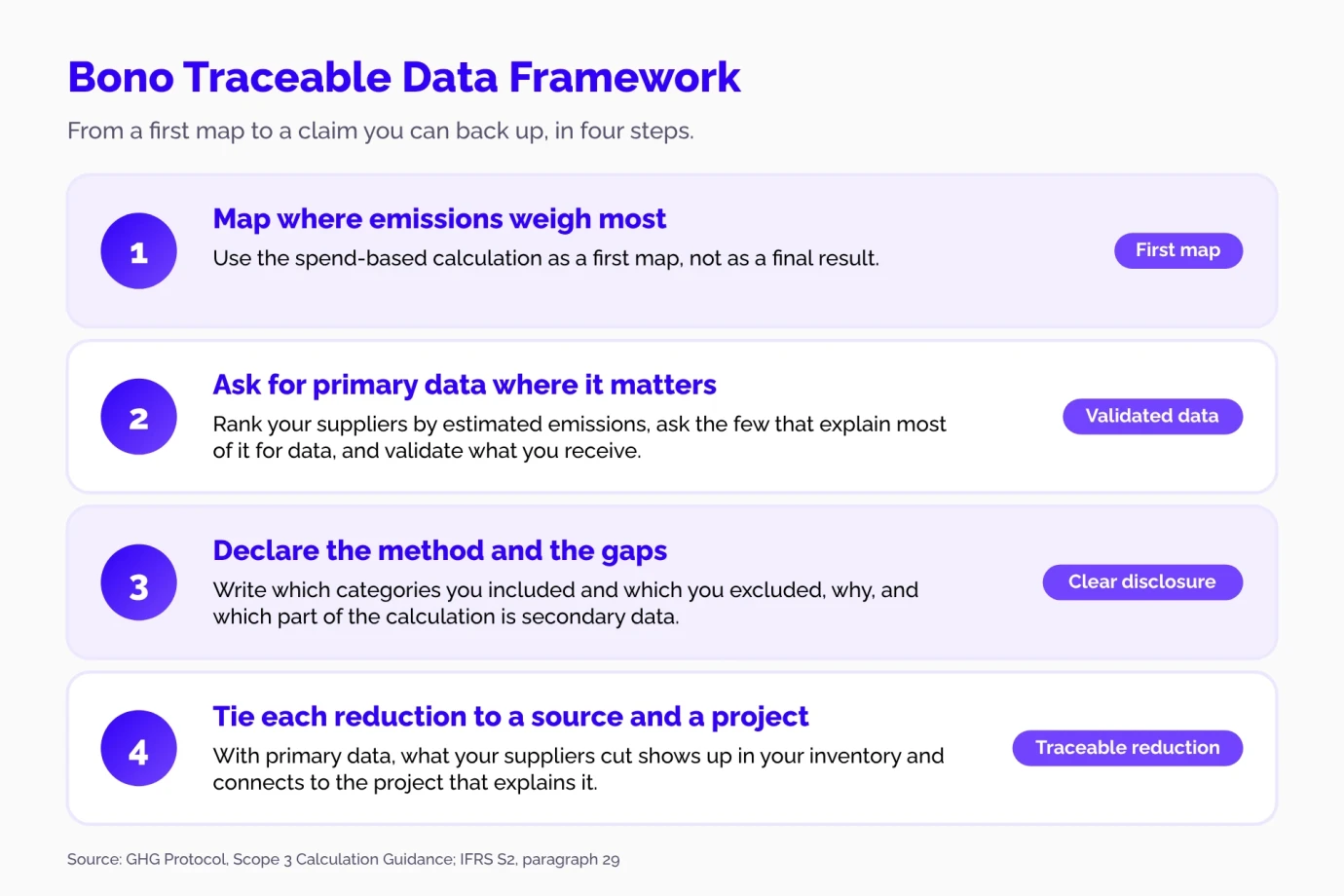
You avoid it by declaring only what the inventory can trace and closing the gaps where they weigh most. The Bono Traceable Data Framework has four steps and goes from a first map to a claim with evidence behind it.
Start with low-specificity methods to see where the emissions are. The technical guidance recommends that initial screening and reserving the most precise data for the categories that emit the most. A spend-based calculation fills that role, as long as you call it a first map and not a final result.
According to the technical guidance, collecting data directly from suppliers adds a considerable time and cost burden. That is why it makes no sense to ask every supplier. Rank your suppliers by estimated emissions and ask for data from the few that explain most of it.
Then validate what you receive. The Bono Supply Chain app makes the direct request and records the data in the inventory, with its source and its period.
Write which categories you included, which you excluded and why, and which part of the calculation is secondary data. The IFRS S2 standard on climate-related disclosures, from the International Sustainability Standards Board (ISSB), asks in its paragraph 29 that you disclose the measurement approach, the inputs and the assumptions, and the Scope 3 categories included. The December 2025 amendments apply from 2027 and do not change the obligation to disclose that approach.
Declaring the gap costs less than hiding it.
With a spend-based calculation, what your suppliers reduce does not show up in your inventory. With primary data it does, and it can be connected to the project that explains it. At Bono we start from one idea: every emissions source should connect to a real mitigation pathway.
The data has to lead somewhere.
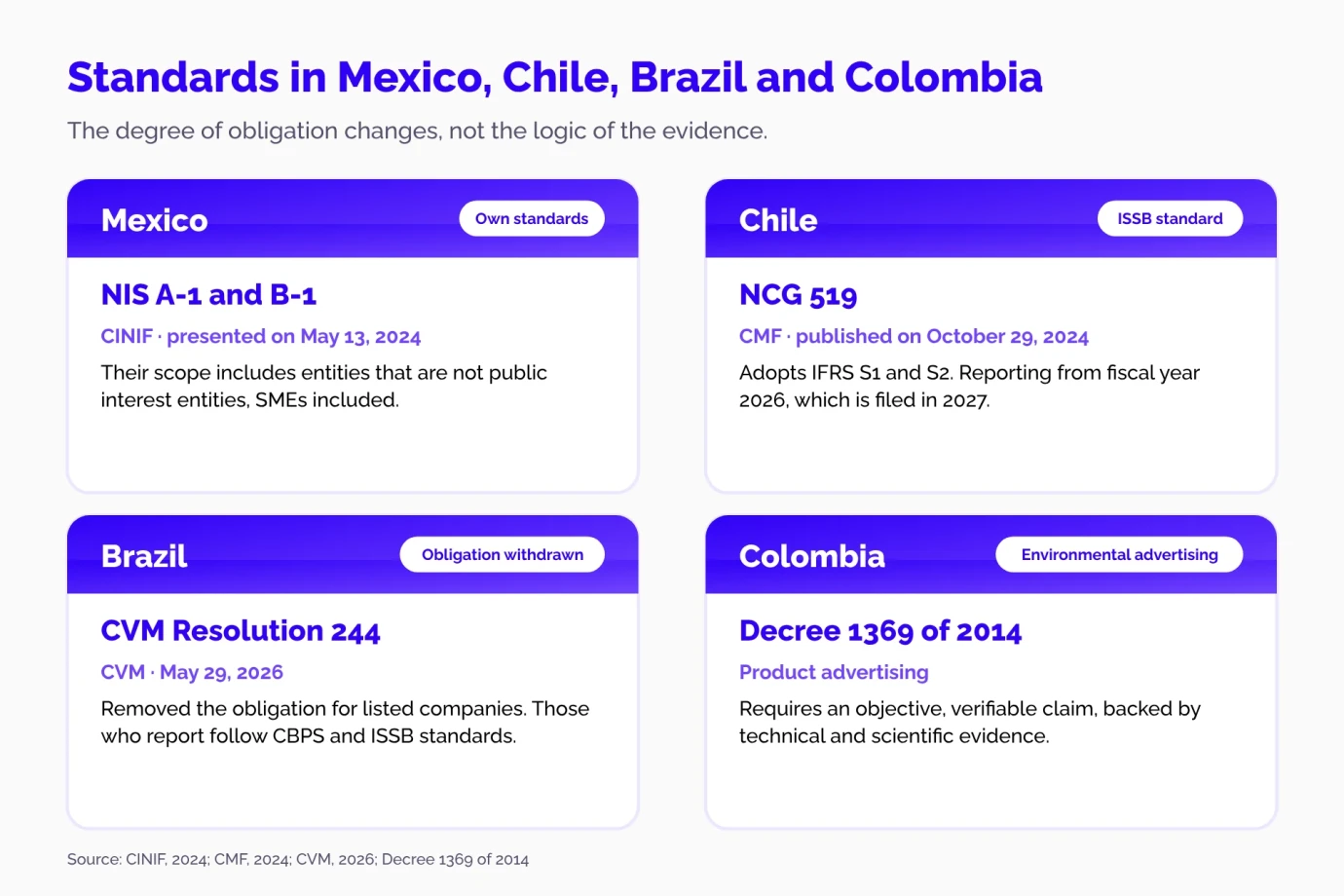
What changes is the degree of obligation, not the logic of the evidence. Brazil withdrew the mandate in 2026, Chile requires the ISSB standard from fiscal year 2026 from certain entities, Mexico has its own standards and Colombia regulates environmental advertising of products.
In Brazil, the Comissão de Valores Mobiliários (CVM) published CVM Resolution 244 on May 29, 2026. It amended Resolution 193 and removed the obligation for listed companies to disclose sustainability information. Those who decide to report must follow the standards of the Comitê Brasileiro de Pronunciamentos de Sustentabilidade (CBPS) and the ISSB, for at least three consecutive fiscal years, and those who do not report must inform the market of their decision.
In Chile, the Comisión para el Mercado Financiero (CMF) published NCG 519 on October 29, 2024. The rule adopts the ISSB’s IFRS S1 and S2. It requires the institutions to which Section II of NCG 30 applies to report under them from fiscal year 2026, which is reported in 2027. Entities with average consolidated assets of up to UF 1 million prepare a simplified report.
In Mexico, the Consejo Mexicano de Normas de Información Financiera y de Sostenibilidad (CINIF) presented the Sustainability Information Standards (NIS) A-1 and B-1 on May 13, 2024. They are a conceptual framework and the basic indicators. Their scope includes entities that are not public interest entities, SMEs included, and CINIF states that those SMEs will provide information to their supply chains.
According to the law firm Greenberg Traurig, the 30 indicators of the NIS B-1 include Scope 1, 2 and 3 emissions, and the standard has been in force since January 1, 2025.
In Colombia, Decree 1369 of 2014 is now compiled in Decree 1074 of 2015. It requires that advertising with environmental qualities of a product be an objective and verifiable claim, with evidence based on recognized technical and scientific procedures. The advertiser must have that evidence available for the Superintendencia de Industria y Comercio (SIC). It regulates product advertising and not the corporate inventory, but it sets the standard of proof that can be requested. [VERIFY DATA: validity notes in official source]
Our reading is that evidence does not depend on each country’s standard. A buyer, a bank or an auditor ask the same question: where does the number come from.
No, if it is declared as what it is. The GHG Protocol accepts spend-based and industry-average methods, which use secondary data. Greenwashing appears when that figure is presented as measured supplier data, or when the method and the exclusions are left out. Declaring the gap is part of doing the calculation well.
Yes, with caveats. The SBTi allows supplier engagement targets as a short-term option to cover 67% of Scope 3 when it weighs 40% or more of the total. That target measures how many suppliers set targets, not how much they reduce. To show reductions you need supplier data.
Ask for the activity data of the product you buy from them, the period, the allocation method and the source of each figure. The GHG Protocol technical guidance notes that granularity, source reliability and allocation define its accuracy. Bono requests that data directly from the supplier and records it in the Scope 3 inventory.
Every reporting cycle with unjustified exclusions is a cycle in which your claim depends on nobody asking.
Want to see it with your data? Book 15 minutes with Bono. We show you where to start before the call ends.