


Below is each point with its source and an example using real factors from Colombia, Chile and Mexico.
Scope 2 emissions get new rules in early 2027, when version 2.0 of the Corporate Net-Zero Standard of the Science Based Targets initiative (SBTi) takes effect. That version changes how the ambition of Scope 2 targets is measured, and that affects how you count your renewable energy purchases.
This article answers four questions: what these emissions are, how the two calculation methods differ, how to calculate them step by step, and which factors to use in Mexico, Colombia and Chile. Let's start with the definition.
They are the emissions from the electricity, steam, heat and cooling that a company buys. The Scope 2 Guidance of the Greenhouse Gas Protocol (GHG Protocol) defines them as a category of indirect emissions: they occur where the energy is generated, not at your plant.
At an industrial plant, that data usually lives in the invoices for each meter. Consolidating it by facility and by month is the first job of the calculation.
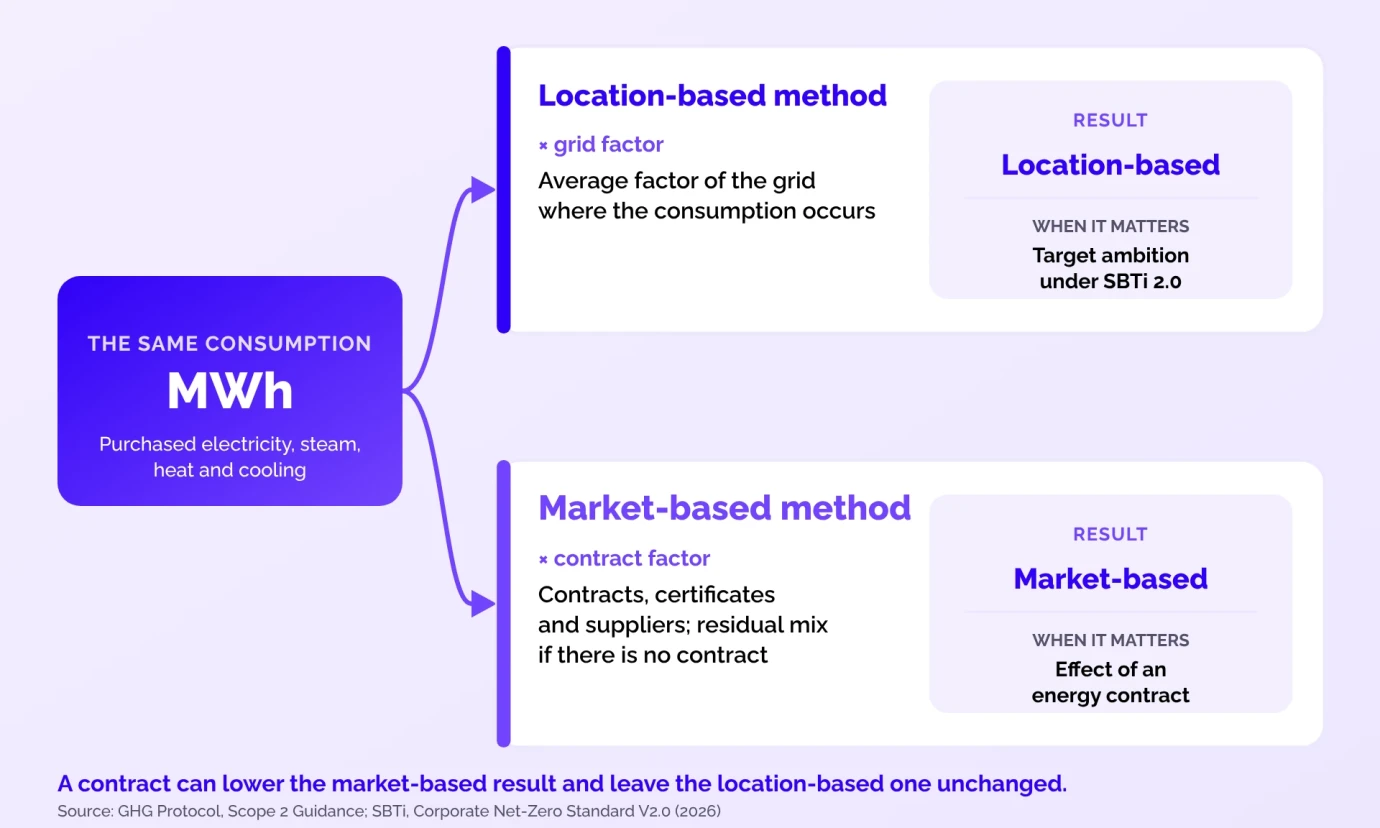
Location-based uses the average grid; market-based uses the contracts you chose. The guidance defines them in its Table 4.1: average generation factors in the first and emissions from the chosen generators in the second.
| Method | What it uses | What it reflects | When it matters |
|---|---|---|---|
| Location-based | Average factor of the grid where the consumption occurs | The intensity of the physical grid | Target ambition under SBTi 2.0 |
| Market-based | Factors from contracts, certificates and suppliers; residual mix if there is no contract | Your energy purchasing decisions | Showing the effect of an energy contract |
With energy contracts in your market, the guidance requires reporting both ways. Each result is labeled by method. CDP asks for the same in its technical note on Scope 2, with one exception: companies that operate only in markets without a market-based method report only the location-based one. If you care about your CDP Score, you will see this rule in question 7.7 of the questionnaire.
A renewable energy contract can lower your market-based result and leave the location-based result unchanged, because the physical grid stays the same. That is the uncomfortable truth of this topic: the progress is in the contract, not in the grid.
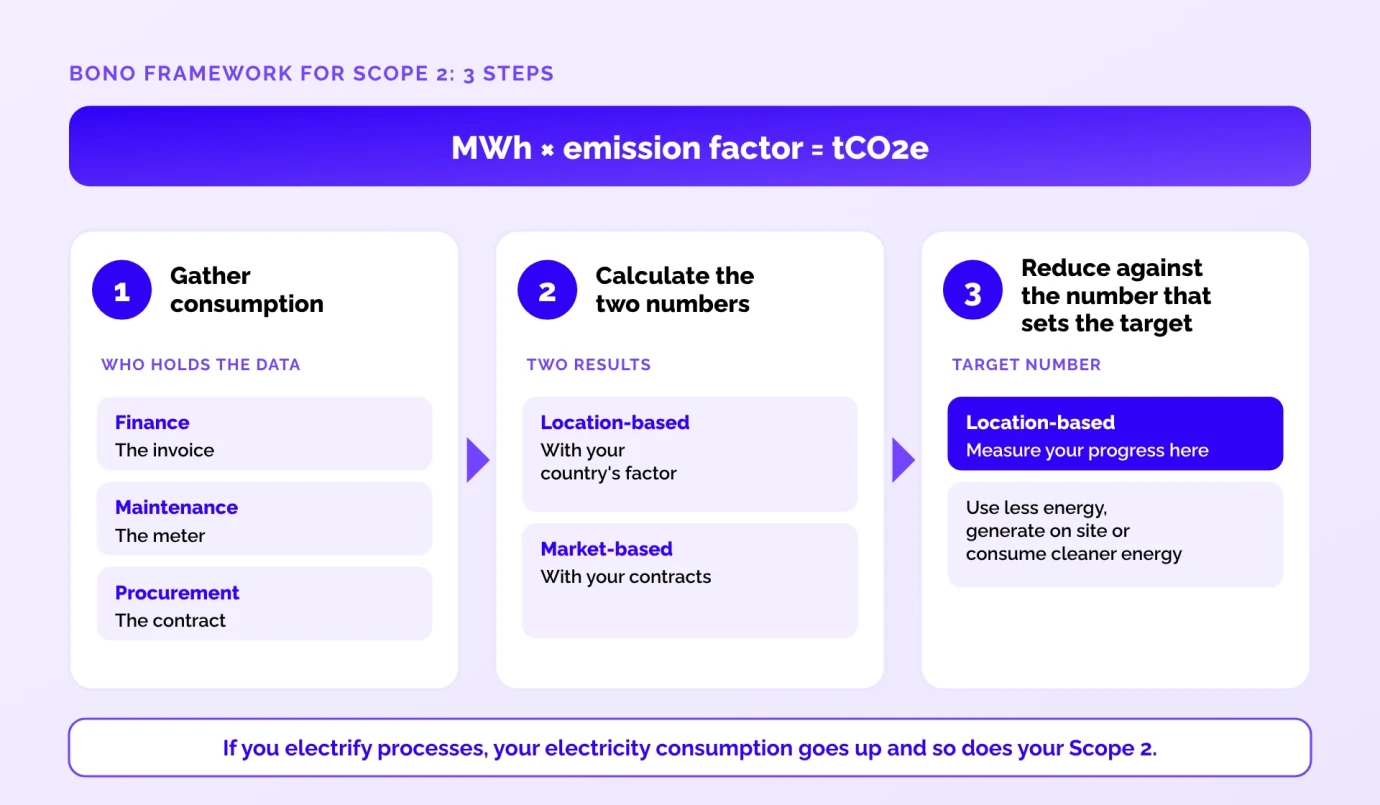
Multiply energy consumption in MWh by the emission factor of the chosen method. The guidance describes it as multiplying activity data by source-specific or supplier-specific factors. Here we apply the Bono Framework for Scope 2: 3 steps, which orders the calculation from data to reduction.
Collect the MWh by facility and energy type. It rarely lives in one area: Finance has the invoice, Maintenance has the meter and Procurement has the contract. Without that order, the most accurate factor gets multiplied by doubtful data. Carbon footprint measurement in industrial companies in LATAM starts right here, with who holds each bill and each reading.
How Bono helps: the Decarbonization Platform pools the operation's data, with unlimited users, so each area uploads its part. Its in-depth analysis shows which activities concentrate the critical emissions.
Calculate location-based with your country's factor and market-based with your contracts. For the market-based method, the guidance accepts supplier-specific factors and, when there is no contract, the residual mix. Before counting a contract, check that it meets the guidance's quality criteria, also if you need to report a renewable energy PPA.
Excel is an audit risk, not a measurement tool. An outdated factor in a hidden cell contaminates the whole inventory.
How Bono helps: the Decarbonization Platform applies emission factors to the consumption you uploaded. It adapts to your operation and works for all industries.
Our position: report both methods and measure your progress by location. The reductions that number recognizes come from using less energy, generating on site or consuming cleaner energy. If you electrify processes, your electricity consumption goes up and so does your Scope 2, so calculate first with your grid's factor. Industrial electrification can be a good project, but you should know that effect before approving it.
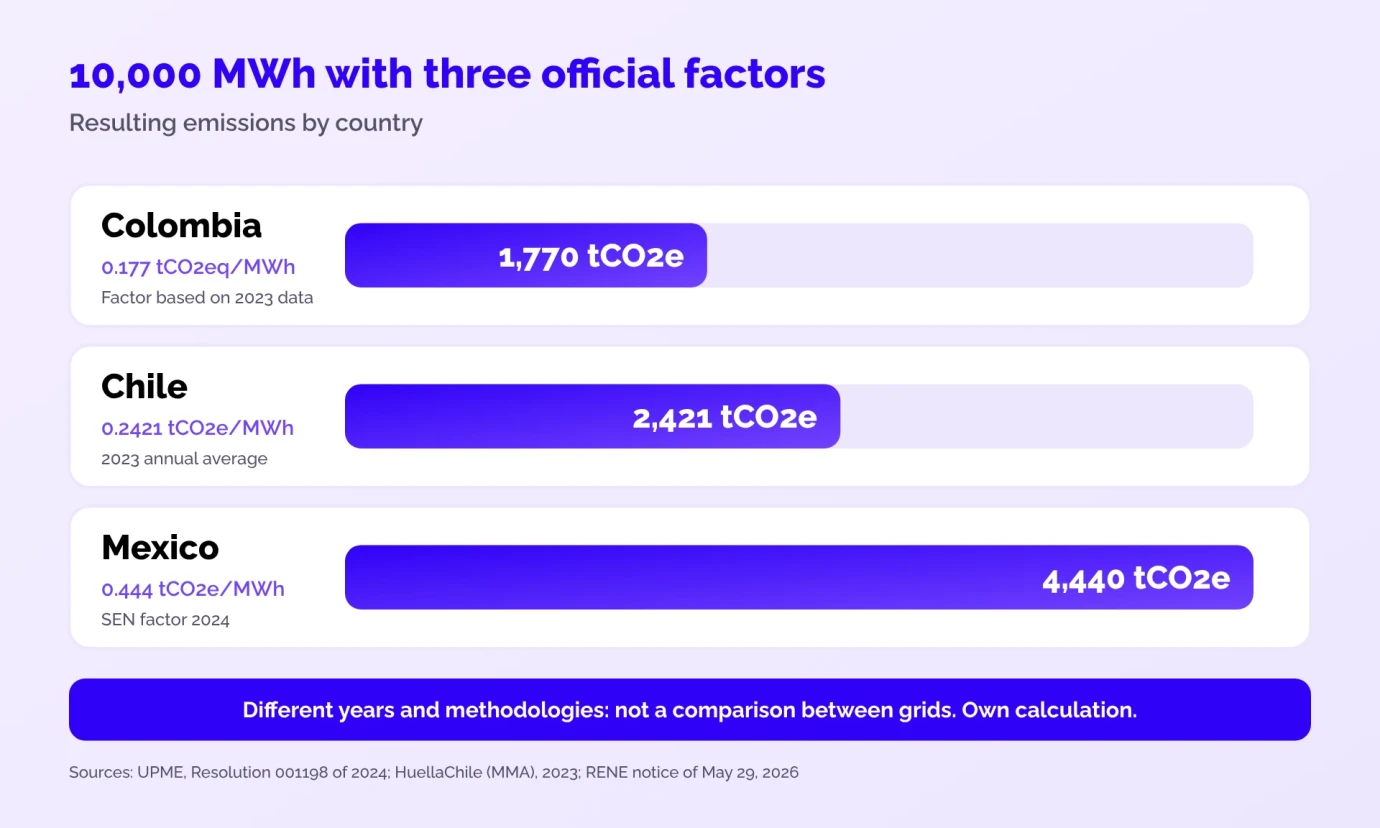
Each country needs its current official factor, because it changes by grid and by year. In Colombia, Resolution 001198 of 2024 from UPME set a factor of 0.177 tCO2eq/MWh for GHG inventories on December 26, 2024, based on 2023 data. In Chile, HuellaChile publishes 0.2421 kgCO2e/kWh as the 2023 annual average of the National Electric System, equivalent to 0.2421 tCO2e/MWh.
In Mexico, the RENE notice of May 29, 2026 said to use the 2024 factor of the National Electric System, 0.444 tCO2e/MWh. It applies to indirect emissions from electricity consumption in the Cédula de Operación Anual (COA) for the 2026 reporting period. The Ministry of Energy was still estimating the 2025 factor.
An example of scale: 10,000 MWh of consumption equals about 1,770 tCO2e with the Colombian factor, 2,421 tCO2e with the Chilean one and 4,440 tCO2e with the Mexican one. This is our own arithmetic. The Colombia and Chile factors are from 2023 and Mexico's is from 2024, and each country uses its own methodology, so this is not a comparison between grids. Confirm that each factor is still current before using it.
The National Emissions Registry (RENE) requires companies that exceed 25,000 tCO2e across all their facilities to report direct and indirect emissions. If you already file the COA, review the carbon data your company already has before asking Operations for new information.
Under SBTi 2.0, target ambition is measured by location. That is what criterion CNZS-C9.4 of version 2.0 establishes. Market instruments are reported separately from that inventory and their volume cannot exceed that of the activity they cover.
The GHG Protocol is still revising its guidance. Its public consultation received nearly 1,100 responses from 56 countries, and the organization says it is exploring multiple reporting approaches. The announcement sets no date for the revised standard, so our reading is that the current guidance remains the reference for now.
Yes, in addition to electricity. The guidance covers the electricity, steam, heat and cooling that you buy or acquire. If you buy steam from a power plant or from an industrial neighbor, that energy also goes into your Scope 2, with its own emission factor.
Both, if your market allows it. If you operate in a market with contractual instruments, the GHG Protocol and CDP ask for both, and companies that only have a location-based method report that one. Bono's Decarbonization Platform uses emission factors to calculate your footprint from the consumption you upload.
It reduces the market-based result, not the location-based one. It only counts if the contract meets the guidance's quality criteria. Under SBTi 2.0, target ambition is measured with the location-based inventory and instruments are reported separately. A contract helps you execute the target, not define it.
Each supplier has its own Scope 2. Only the supplier has the consumption data, so you have to ask for it. Bono's Supply Chain sends maturity surveys and sustainability reports to suppliers, and ranks the chain by maturity level to prioritize the critical ones.
Every quarter with a single Scope 2 number is a quarter in which you do not know how much of your progress comes from the grid and how much comes from your contracts.
Want to see it with your data? Book 15 minutes with Bono. We show you where to start before the call ends.