


If you already know your case, skip to the table. If not, let's start by defining what you are buying when you hire outside help.
In 2025, CDP asked more than 45,000 suppliers to report environmental data, at the request of the companies that buy from them. These are requests sent, not responses received, but behind each one there is an executive who has to decide which environmental consulting service for companies to hire.
The search almost always runs into proposals that list services without asking what problem you want to solve. An audit, an emissions inventory and a filing with the authorities don't cost the same or take the same time.
This article answers four things: what environmental consulting is, what your SME needs (permits, customer requests, footprint measurement or reduction projects), what to prepare for the first meeting and what to ask when comparing proposals. Let's start with the basics.
Environmental consulting for companies is an outside service that assesses how a company operates against its environmental obligations and impacts, and helps it resolve them.
The problem is that this definition covers very different jobs. A consulting firm can process a permit, audit a plant, calculate emissions or design an energy efficiency project, and our reading is that a single firm rarely does all four well. In an SME without a sustainability team, environmental matters also tend to fall on one person, often in Operations or Quality, who handles them alongside their regular job.
That's why it pays to start with the need, not the catalog.
Bono sorts needs into four: complying with a regulatory requirement, responding to a customer, measuring your carbon footprint or reducing emissions and costs. Each calls for a different type of support, and the most useful clue is who is asking you for what.
If an authority asks you for something, your need is compliance. In Mexico, facilities in six sectors must report their direct and indirect emissions to the National Emissions Registry (RENE) when they exceed 25,000 tonnes of CO₂e per year. The sectors are energy, industry, transport, agriculture and livestock, waste, and commerce and services.
That report is filed through the Annual Operating Certificate (Cédula de Operación Anual, COA), a digital filing that compiles emissions to air, water and soil. Before assuming whether or not it applies to your company, a regulatory specialist should review your facilities.
This need is served by a law firm or an environmental regulatory consultancy. It is legal and permitting work, and Bono doesn't do it.
If a buyer asks you for emissions data, your need is to respond with a number you can defend. The customer rarely wants a long report. They want an inventory with a documented method and an explanation of what was measured and what wasn't.
If you export to Europe, the Carbon Border Adjustment Mechanism (CBAM) places the obligation on the European Union importer. Its definitive regime has applied since January 1, 2026. Our reading is that, for a Latin American supplier, the practical effect is that its European customer will ask it for emissions data.
If your customer has science-based targets, the SME route of the Science Based Targets initiative (SBTi) is a useful reference. According to the SBTi FAQs for SMEs, in version 1.0 from July 2020, an SME is an independent company with fewer than 500 employees. That route requires Scope 1 and 2 targets and does not require Scope 3 targets, although the company commits to measuring and reducing it.
This is where Bono fits. Measuring Scope 1 and 2 with a documented method is exactly what these requests need.
If you want to know your footprint before anyone asks for it, you need an inventory. In its corporate standard, the GHG Protocol (Greenhouse Gas Protocol) defines Scope 1 as emissions from sources the company owns or controls. Scope 2 covers emissions from the electricity it purchases. Scope 3, which covers all other indirect emissions, is an optional reporting category.
Starting with Scope 1 and 2 is common practice and also our recommendation. It covers what you control and what you pay on your energy bill, and leaves a baseline to expand from later.
An inventory is useful if it can be repeated the following year with the same data.
If you already know where you emit, your need is to decide which project to do first. That requires actual consumption per facility, an estimate of savings and investment, and a prioritization criterion. A consultancy that delivers the inventory and stops there leaves this part to you.
This is Bono's position: data has to lead somewhere.
Sometimes a customer or a tender requires certification. ISO 14001 is the international standard for environmental management systems and applies to organizations of all sizes. The 2015 edition appears as withdrawn on the ISO website and is replaced by ISO 14001:2026, so confirm with the certification body which edition and which transition period apply to you.
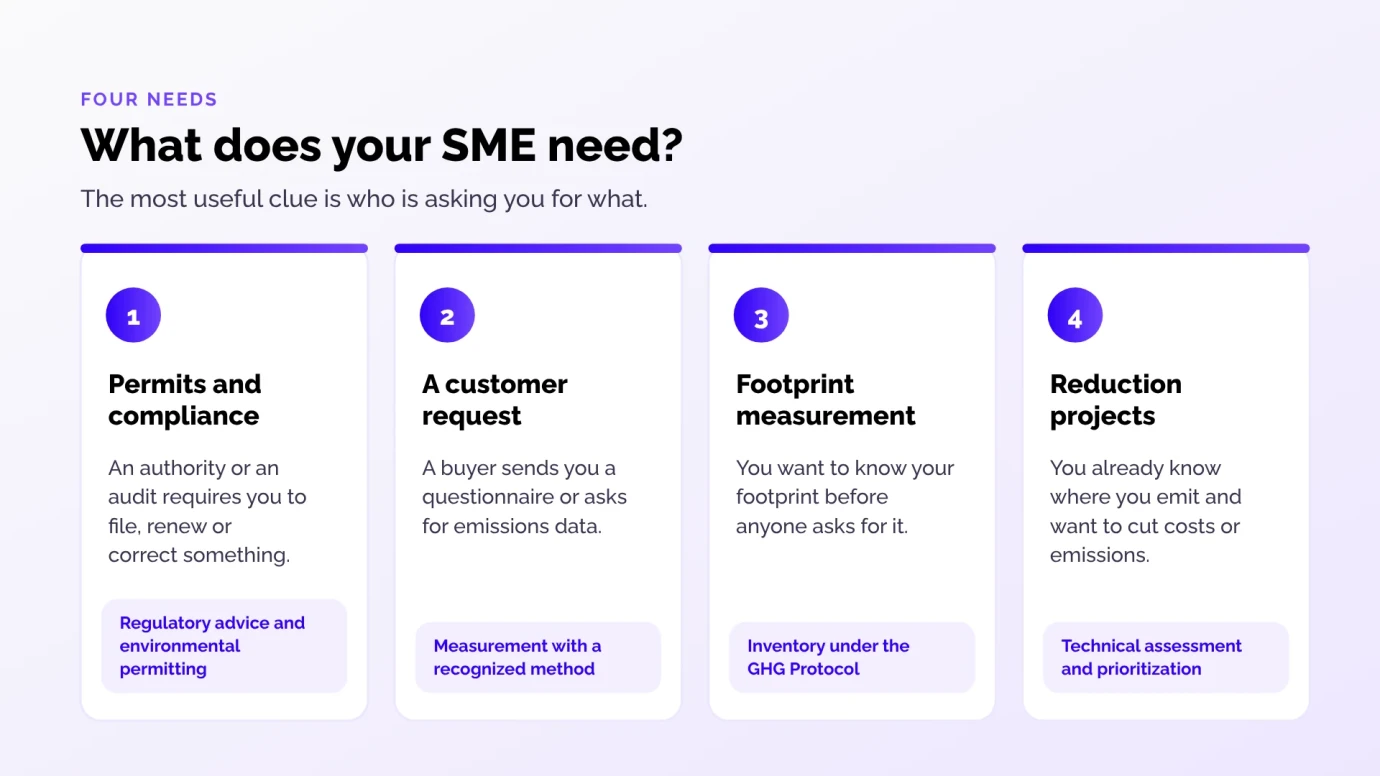
Each need calls for different support, and a consultant's proposal should name the specific deliverables you will receive. A proposal that doesn't name them still doesn't tell you what you're buying.
| Need | Sign that it's yours | Type of support | Deliverables you should ask for |
|---|---|---|---|
| Permits and compliance | An authority or an audit requires you to file, renew or correct something | Regulatory advice and environmental permitting | Assessment of obligations per facility, filing calendar, filings submitted |
| A customer request | A buyer sends you a questionnaire or asks for emissions data | Measurement with a recognized method and support to respond | Scope 1 and 2 inventory with a documented method, questionnaire answers, list of missing data |
| Footprint measurement | You want to know your footprint before anyone asks for it | Inventory under the GHG Protocol | Inventory, emission factors used, template to collect data every year |
| Reduction projects | You already know where you emit and want to cut costs or emissions | Technical assessment and prioritization | Prioritized list of projects with savings, investment and payback, calculated with your actual consumption |
| ISO 14001 certification | A customer or a tender requires certification | Implementation and support through certification | Environmental policy, procedures, internal audit, plan toward the certification body |
The measurement and reduction rows are where Bono fits. Bono's infrastructure measures Scope 1 and 2 with Carbon Accounting Starters, and Scope 1, 2 and 3 with Pro. That way the inventory stays as data that lives in your operations and is updated every year, not as a file delivered once.
The permits and certification rows require regulatory specialists and certification bodies, and it's better to say so from the start.
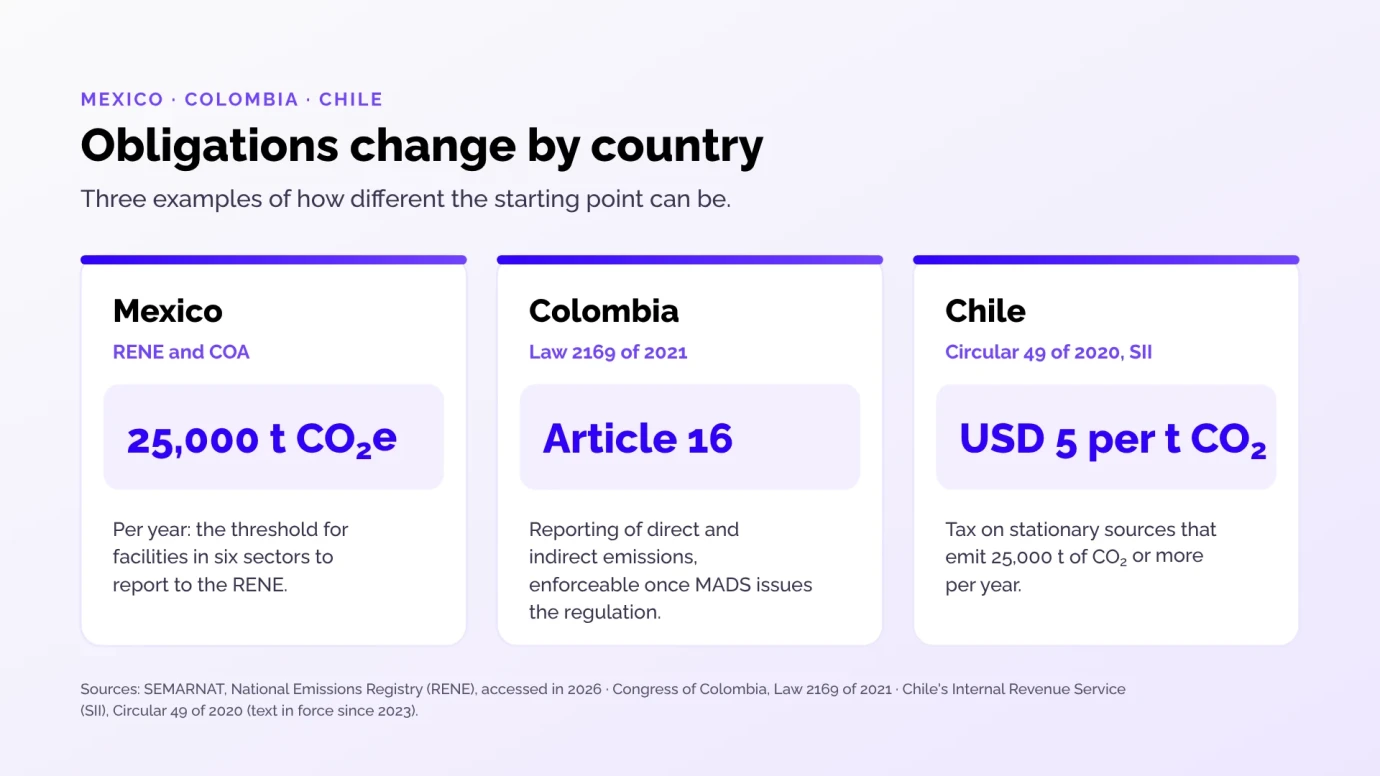
Bring to the meeting a named need, the origin of the request, the data you already have and the budget you can commit. With that, the consultant can propose something concrete instead of a catalog.
Step 1. Name the need. Pick one of the four in the table, even if you suspect it's two. If in doubt, write the sentence the way you'd say it out loud: "my customer asked for my carbon footprint by March."
Step 2. Gather where the request came from. Collect the customer's email, the questionnaire or the authority's requirement, with its deadline. The deadline defines whether you need a quick inventory with the data you already have or longer-term work.
Step 3. Collect the data that already exists. Electricity bills, fuel consumption and gas invoices are usually enough for a first Scope 1 and 2 inventory. In practice, consumption data per line lives in an Excel file nobody has opened again, and it helps to know who keeps it before the meeting. Bono starts from those same bills and consumption records and keeps them on a platform so the calculation can be repeated the following year.
Step 4. Define who decides and with what budget. The person who signs off on the budget is rarely the one who has the data. If Procurement received the request, Finance approves the spend and Operations keeps the consumption records, invite all three to the meeting.
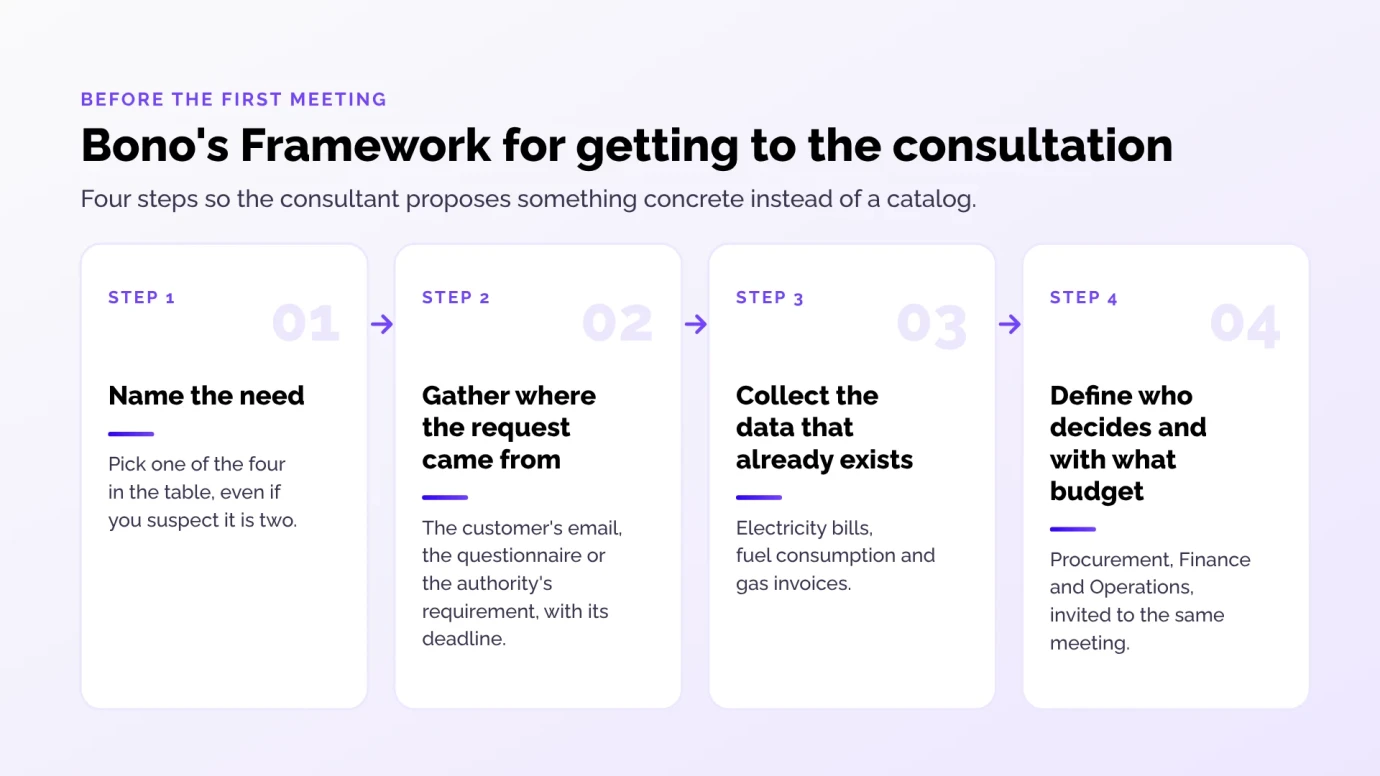
Ask what each proposal includes, what falls to you and what happens after they deliver the assessment. A clear proposal answers all three without beating around the bush.
On scope, ask it to separate what the consultant will do from what your team will do, and to name each deliverable. If the proposal measures emissions, ask which method and emission factors it uses, and whether you'll be able to audit where each number came from. Also ask about experience in your sector and your country, because a filing in Mexico and one in Colombia are nothing alike.
On the data, ask where it ends up. Excel is an audit risk, not a measurement tool, and an inventory that lives in one person's file is lost when that person changes roles.
On what comes next, ask what happens the following year and who updates the inventory. An 80-page PDF describes the problem; a data infrastructure moves it. If the proposal ends with the report, the next step, which is deciding on reduction projects, is left without an owner.
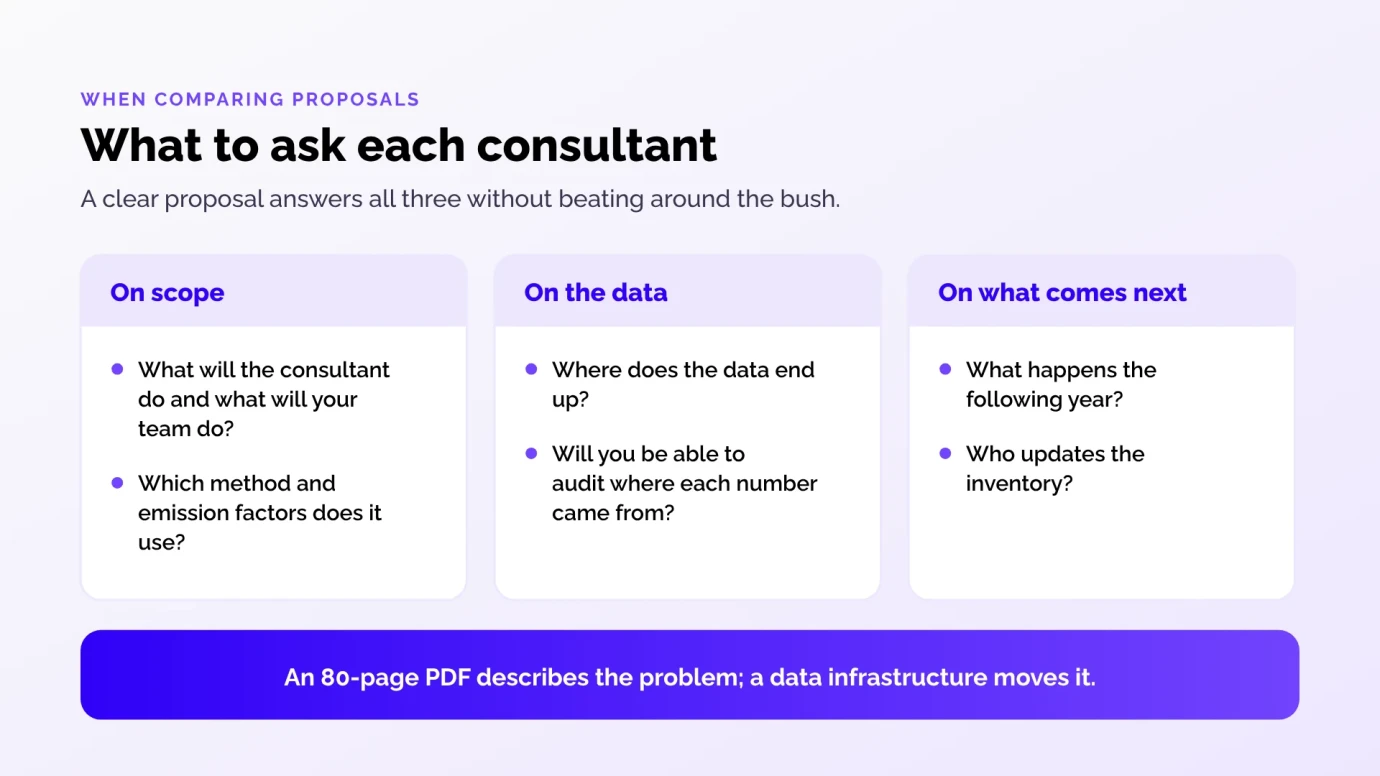
Obligations change by country, which is why a consultant's first task is to tell you which rules in your country and sector apply to your facilities. These three examples show how different the starting point can be.
In Mexico, reporting to the RENE and the COA described above set the regulatory floor for facilities that exceed 25,000 tonnes of CO₂e per year.
In Colombia, Law 2169 of 2021 sets minimum targets and measures for carbon neutrality and climate resilience. Its Article 16 requires legal entities to report their direct and indirect emissions. The Ministry of Environment and Sustainable Development (MADS) will define the criteria based on emissions level and company size.
The obligation becomes enforceable once MADS issues that regulation, so ask your consultant to confirm whether it's already in force for your sector.
In Chile, Circular 49 of 2020 from Chile's Internal Revenue Service (Servicio de Impuestos Internos) describes the tax on stationary polluting sources. For CO₂, under the text in force since January 1, 2023, it taxes sources that emit 25,000 tonnes or more per year at 5 dollars per tonne emitted.
In practice, a supplier in Monterrey, one in Bogotá and one in Santiago can receive the same questionnaire from a customer and have very different local obligations.
It depends on the scope, and we didn't find a sourced reference rate we can cite. What helps is asking for the proposal broken down by deliverable, with the work the consultant will do and the work that will fall to you. Compare by deliverables, not just by total price.
It depends on the country, the sector and the emissions level. In Mexico, reporting to the RENE applies to facilities in the listed sectors that exceed 25,000 tonnes of CO₂e per year. Below that level, the reason to measure is usually a customer request or your own interest in cutting costs.
You can start that way, but Excel is an audit risk, not a measurement tool. Every year someone has to reconstruct which factor was used and where each data point came from. Bono measures Scope 1 and 2 on a platform designed to repeat the calculation year after year.
The consulting firm brings judgment and tailored work, and the platform brings data that is repeatable and auditable. A permit or a certification requires a specialist. An annual inventory and its reduction pathway call for infrastructure, and that's what Bono covers.
Every meeting with a consultant without a named need ends in a catalog proposal.
Book 15 minutes with Bono. Come with your need named and we'll tell you whether it fits what we do and where to start, before the call ends: